Chuck D addressed the Class of 2013 and received an honorary doctorate from his alma mater.
by Bonnie Eissner
Earning a place in the is no mean feat. But only the most revered rockers make it into the hallowed hall in their first year of eligibility���25 years after a debut album. Last April, , the rap group with Adelphi roots, became the first hip-hop band to join this elite group.
For Public Enemy founder Carlton D. Ridenhour ���84, ���13 (Hon.), better known as Chuck D, the induction was a favorite moment in a career that���s rich in milestones. Momentously, he chose Harry Belafonte and Spike Lee to do the honors.
Just over a month later, Chuck D was at Adelphi���s Commencement to collect another accolade���an honorary doctorate from his alma mater. Grace, gratitude and panache abounded in his short and much-tweeted address to the Class of 2013. ���I truly, truly, from the bottom of my heart, salute the Class of 2013,��� Chuck D said. ���You hear celebrities talk about swagger. Y���all got the real swagger. This [your diploma] is something to swagger with.���
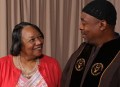 Chuck D came to Commencement with his mother, Judy Ridenhour, M.S.W. ���88, and two of his three daughters. His wife, Gaye Theresa Johnson, Ph.D., was unable to join him, but sent remarks about him. ���Anyone who knows the evolution of ���Chuck D��� (the artist), knows how prominently Adelphi figures into the solid foundation that underlies your career and approach to music,��� she wrote.
Earning his first Adelphi 餃梗眶娶梗梗���a ���took the former graphic design major six years. ���I went there [to campus] every single day; I just didn���t go to class,��� Chuck D told the Class of 2013. ���They sat my ass down in 1979 and put me on suspension.��� But the dean of the ���Harold Davies���made a deal with Chuck D, agreeing to reinstate him if he negotiated with his professors to make up his incompletes by attending class and doing the work.
Art and Art History Professor Richard Vaux was one of the professors with whom Chuck D bargained. ���I thought he was very talented right from the beginning,��� Mr. Vaux recalls. ���But��多e probably missed a third of the classes.��� Once Chuck D set his mind to retaking the foundation art classes he had skipped, Mr. Vaux says, he ���was a total turnaround; he was a serious student.���
In the words of Chuck D, ���I was a phenom in my department. I treated it like a business.��� He points to his cartoon series for The Delphian, Tales of the Skind. He envisioned creating art for record labels, until his avocation became his vocation.
���You know, he���s always had a band,��� Judy Ridenhour says. ���If you were to walk through my house, it��吆was] a constant beat all the time, but I didn���t know he was going to try to make a living at it,��� she adds, laughing.
���My Bachelor of Fine Arts degree was galvanized by the music,��� he said at Commencement.泭First, there were the Thursday Night Throwdowns at the Ruth S. Harley University Center where DJs would play hip-hop. ���They used to have an open mic,��� Chuck D recalls. ���I would get on the microphone and start rocking the house.��� Future Public Enemy producer Hank Shocklee, who泭then headed a mobile DJ unit, Spectrum City, heard Chuck D rapping at Adelphi and invited him to join Spectrum.
Adelphi African-American Studies faculty member and jazz drummer Andrei Strobert, who taught the Black Music and Musicians course, inspired Chuck D and his friends, including the rapper Andre ���Dr. Dre��� Brown, with his exposition on the African sources of contemporary music, such as jazz and rap. ���He was a great man,��� Chuck D says.
In 1982, fellow Adelphi student Bill Stephney, who was the program director at , the campus radio station, gave Chuck D and other Spectrum City members their own show, The Super Spectrum Mix Hour. Chuck D credits Mr. Stephney as ���the first person to incorporate and orchestrate rap music into college radio.���
Chuck D is especially fond of his WBAU days. ���We did the best radio shows ever,��� he recalls.泭He longed to bring rap to mainstream radio, but was stymied. ���I thought rap was an art form��夷t deserved better treatment on the radio,��� he says. ���But radio was just such a tied-up industry.��� Ultimately, Mr. Stephney, who had started working for (and would rise to become president of the label), convinced Chuck D to cut a record. ���I turned Def Jam down for like a year because I just didn���t see it working,��� Chuck D recalls.
Eventually, he relented and, according to Mr. Stephney, Chuck D came on as an artist with the flamboyant Flavor Flav. Hank Shocklee was a co-producer, and Mr. Stephney was a producer. Together they formed Public Enemy. Later, Chuck D brought on the other eclectic and iconic Public Enemy members���the martial arts-loving Professor Griff and the intimidating DJ Terminator X.
Much of the rest of Public Enemy���s rise is, as Chuck D says, public record. The group���s debut album, released in 1987, Yo! Bum Rush the Show, achieved some critical acclaim, especially in Europe. The group truly broke out, though, with its second record, 1988���s, which sold more than a million copies.
Mr. Stephney recalls that Public Enemy emerged from a rich hip-hop culture, in an era when fellow hip-hop bands, such as Run DMC and the Beastie Boys, sold albums by the millions. ���You can���t sell 800,000 copies of Justin Timberlake today,��� Mr. Stephney says. He remembers that ���The Beastie Boys loved Public Enemy��同eople think of Public Enemy as this super-militant group, but the group that fought hard to expose Public Enemy to the world was the Beastie Boys.���
Through Mr. Stephney, Public Enemy connected with filmmaker Spike Lee and wrote the theme song, ���Fight the Power,��� for Do the Right Thing, Mr. Lee���s incendiary 1989 drama about racism. The song, which is part homily, part rallying cry, established Public Enemy as a group willing to speak its perception of truth to power. The song includes samples from James Brown and Bob Marley, and some of the lyrics convey Public Enemy���s response to racist comments made by Elvis and John Wayne. Being attached to Spike Lee���s widely released and talked about泭film brought Public Enemy and its founder, who was only in his late 20s, further into the mainstream.
At the height of its fame, Public Enemy brought on its own maelstrom, which started when, in an interview with , Professor Griff, the group���s ���minister of information,��� called Jews ���wicked.��� Chuck D remembers that the comments grew out of a discussion the group had with reporters about the situation ���in Israel and Palestine.��� He explains: ���Some of the writers were being defensive on the anti-Palestinian side, and it just hit a bad road with泭Griffin. And from that interview, then there was another interview that was done, and it just snowballed��吏f course, they were shallow comments that should not have been isolated.���
After a month of outcries, Chuck D dismissed his friend. Later, Chuck D apologized and hired Professor Griff back. The band, though, stayed controversial, particularly with its single ���Welcome to the Terrordome,��� which referenced Louis Farrakhan���s anti-Semitic stance. The hype surrounding Public Enemy���s music brought the group nearly as much attention as the music itself.
Today, Chuck D continues to tour internationally and cut albums with Public Enemy. He said he sees himself as a ���raptivist��� or ���artcademic��� and regularly preaches the importance of education, particularly in speeches he has made at hundreds of colleges. A former board member of the advocacy group TransAfrica, he has more than 250,000 Twitter followers (). ���We have the potential to make change, just like Bob Marley and Bob Dylan, so why not?��� he says.
For further information, please contact:
Todd Wilson
Strategic Communications Director泭
p ��� 516.237.8634
e ��� twilson@adelphi.edu